
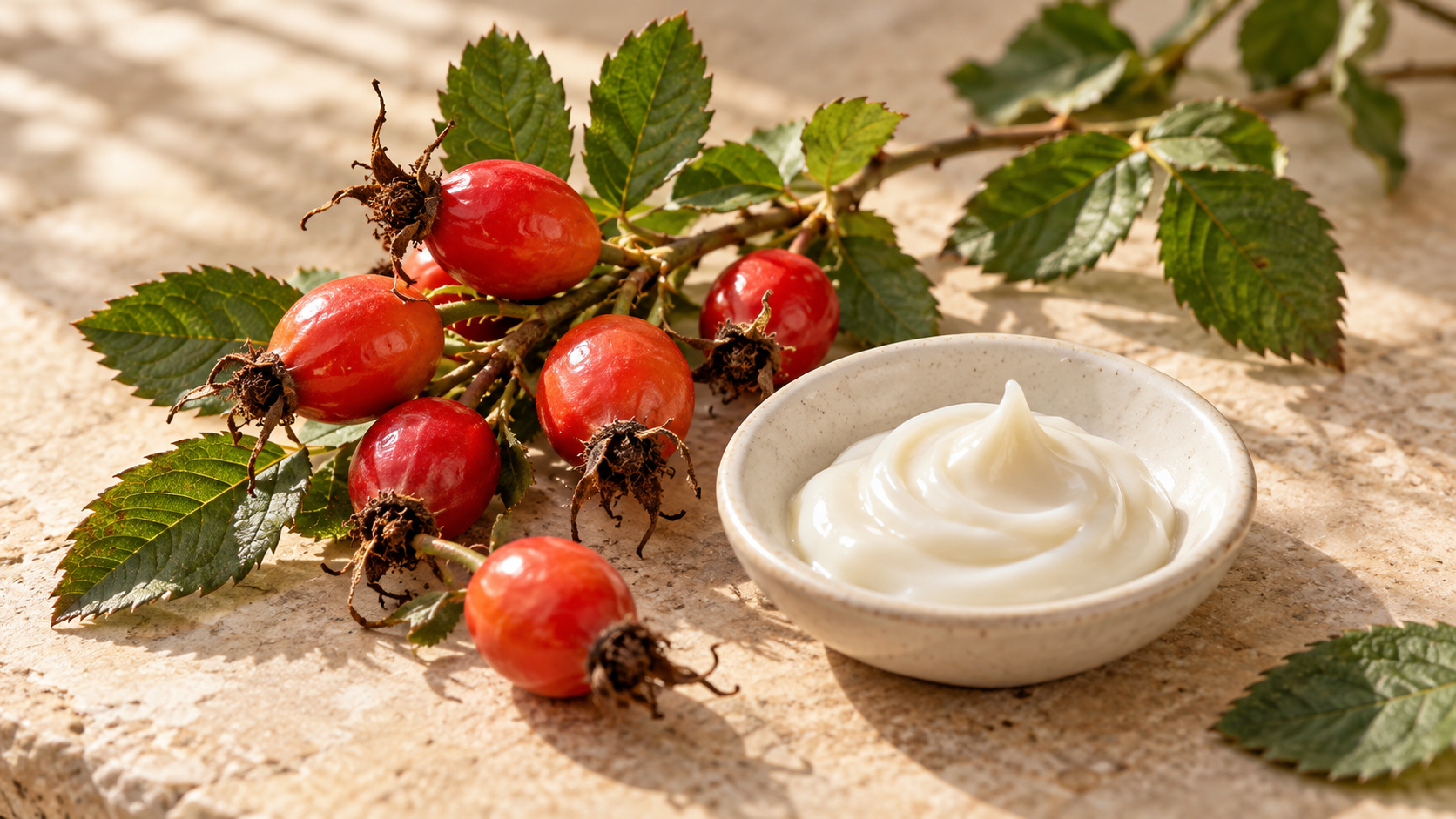

Rosehip is used in facial oils and creams for skin care. Its cosmetic appeal lies in its lipid content and its role as an emollient: an ingredient that helps keep skin soft. Claims about dark spots, wrinkles or scars need a more nuanced explanation.
Before choosing a product, it helps to distinguish between rosehip oil and a cream that contains it. Their ingredients, texture and directions for use can be very different, even when the same ingredient is highlighted on the packaging.
What is rosehip oil?
Rosehip oil is a plant oil obtained from the seeds of certain rose species. Studies of its composition identify fatty acids such as linoleic and linolenic acid. You can read an analysis of rosehip seed oil published in Grasas y Aceites, a scientific journal published by the Spanish National Research Council (CSIC).
Understanding these components helps explain the interest in this ingredient, but it does not prove that every cosmetic product containing rosehip will deliver the same results. Analysing an oil is also not equivalent to testing a finished face cream.
Rosehip benefits for the face: what to expect
Softness and care for dry skin
Rosehip oil is used as an emollient. In a facial formulation, this type of ingredient helps soften the skin and supports the care of dry skin.
The NHS explains that emollients help soften the skin and trap moisture. This describes their general function; it is not an assessment of any particular rosehip oil or cream.
If you choose a cream, its moisturising effect depends on the formulation as a whole. When a product combines several ingredients, its effects cannot be attributed to just one of them.
Skin appearance: findings that still need confirmation
Rosehip is also being studied for its potential effects on the appearance of facial skin. A pilot study published in Cosmetics in 2025 examined changes in features such as wrinkles and dark spots during the use of rosehip oil.
The authors themselves highlight important limitations, including a small sample, a short study period and the lack of a control group. These findings therefore cannot be presented as a guarantee that rosehip removes dark spots or wrinkles, or applied directly to any cream that contains it.
Rosehip oil or face cream?
The choice depends on the product and the texture you prefer. Consider these differences before buying:
- Oil: check whether the product contains only rosehip oil or is a blend. Follow its specific application instructions.
- Cream: check the full formulation, whether it is intended for facial use and the manufacturer’s instructions. The results do not depend on rosehip alone.
- Both options: check the precautions and look for any ingredients you know your skin does not tolerate.
If you are comparing creams that also contain aloe vera, our guide to choosing an aloe vera cream from the Canary Islands can help you decide what to look for.
How to use rosehip in your facial skincare routine
Choose a cosmetic product intended for facial use and follow the amount and frequency of application stated on the packaging. There is no single set of instructions that applies to every oil and cream.
Introduce the product without changing your entire routine at once. This will make it easier to identify what works for your skin and what does not. Apply it gently and avoid any areas specified by the manufacturer. Stop using it if irritation occurs.
You do not need to add oil to a cream you already use. Mixing products yourself does not guarantee any additional benefit. Our guide to facial skincare with an aloe vera cream can help you organise the basic steps of your routine.
Frequently asked questions about rosehip for the face
Does rosehip remove dark spots?
There is no guarantee that it will remove them. Research into changes in pigmentation does not justify claiming that every product containing rosehip is a treatment for dark spots.
Can it remove scars?
You should not expect a cosmetic product to erase a scar. If you want to care for a recent scar or an area that has undergone surgery, ask a healthcare professional which product is appropriate and when you can start applying it.
Is it suitable for all skin types?
Being plant-derived does not guarantee that an ingredient will be well tolerated. In addition to the oil, a cream may contain fragrance and other ingredients. Check the full formulation, especially if you have a history of skin reactions.
Choose your facial skincare
In Tabaiba Cosmética’s face creams category, you can compare the formats and features of each option. Before choosing, check the product label and its intended use.